Intensive agriculture is considered as a major cause of the decline of insect diversity and biomass in Germany. Within the frame of the national action programme for the conservation of insects, FInAL (2018 at least until 2025) therefore established Landscape Laboratories in representative agricultural landscapes of Germany where we develop, demonstrate and evaluate innovative measures for facilitating insects through integrated cultivation of renewable resources in a landscape context. […]
FInAL receives funding for another three years
We, the scientists and the practitioners in the regions, are delighted to receive further funding by the Federal Ministry of Agriculture, Food and Regional Identity (BMLEH) and the project sponsor FNR under the funding scheme ‘Sustainable Renewable Resources’ to continue our joint project FInAL from 01/01/2026 to 31/12/2028.

FInAL is part of the European Network of Agroecology LLs and RI in the Agroecology Partnership
Since April 2025, the joint project FInAL is a full active member of the European Network of Living Labs and Research Infrastruktures. More about the aims of the network here, which was launched in 2024 as part of the Agroecology Network. Funded by Horizon Europe, EU’s key funding programme for research and innovation. Find details of all partners in the European Network of Agroecology LLs and RI here and a list. Currently (March 2026), there are 55 members in the European Network of Agroecology LLs and RIs, encompassing 39 Living Labs.
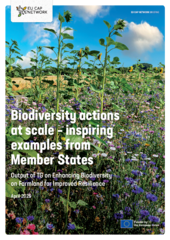
FInAL inspires - EU CAP-Publikation "Biodiversity actions at scale – inspiring examples from Member States"
The EU CAP Network depicts examples of initiatives that promote collaborative biodiversity action on farmland beyond the single farm. FInAL is one of them (see page 12).
[…] The aim of FInAL is to demonstrate how diversity, biomass and functionality of insects can be enhanced in agricultural landscapes, especially through integration of renewable resources and implementation of methods of integrated pest management. We consistently adopt a landscape approach based on regionalised guiding principles (‘Leitbilder’) that encompasses both agricultural land and non-cultivated areas and involves the participation of stakeholders. The Landscape Laboratories, i.e. the landscape sections where measures for facilitating insects will be established, will be investigated with respect to their initial state, land-use options, and effects of the measures on different features, primarily in relation to incidence and functionality (e.g. in integrated plant protection) of various groups of insects.
The term Landscape Laboratory denotes a section of an agricultural landscape in which innovative measures for facilitating insects in cultivation systems are conducted. This involves a spatially extensive approach, i.e. the whole area of the Landscape Laboratory constitutes the object of study and, consequently, is transformed by specific measures in its entirety. Therefore, a Landscape Laboratory is to comprise both cropland and grassland as well as those parts that are not under agricultural production. The size of a Landscape Laboratory is approximately 3 x 3 km in order to prove the effectiveness of the established measures with respect to occurrence of insects on the landscape scale. The effects of the measures on various groups of insects, ecosystem services of insects and soils, landscape structure, agricultural production and integrated plant protection will be investigated through monitoring at the start (baseline) and during the transition phase of the landscape and through simultaneous surveys of reference landscapes within the same regions as the respective Landscape Laboratories. For this purpose, we will develop specific evaluation methods. The monitoring will focus on insects and ecosystem services, but also consider all of the four domains of sustainability – ecology/biodiversity, economy, society and politics in an interdisciplinary way in order to allow for a comprehensive evaluation of the measures in terms of sustainability. The selection of the Landscape Laboratories will particularly consider landscape types with high importance for the variety of agricultural landscapes in Germany.
In this project, the choice and implementation of suitable measures will be based on a co-design process involving stakeholders. Prior to the establishment in the Laboratories, the measures will be pre-evaluated at testing sites (‘Maßnahmenwerkstätten’), if necessary. The results from the Landscape Laboratories will be summarised and assessed in an integrative way with respect to effectiveness of measures, acceptance by practitioners, transferability to other agricultural landscapes and options for schemes of agricultural policies.
Contact
Project coordination
Thünen-Institut für Biodiversität
Bundesallee 65
38116 Braunschweig
Phone +49 (0)531 596 2596
E-mail bd-final-info@thuenen.de
Project funding
FInAL is supported by the German Federal Ministry of Food and Agriculture (BMEL) via the Agency for Renewable Resources (FNR) based on a decision of the Parliament of the Federal Republic of Germany.